Five practical approaches to fast-track AI skill development across the workforce
Most organizations now report regular AI use somewhere in the enterprise, yet only about a third have progressed beyond pilots and experimentation to scale AI in a way that delivers consistent, enterprise-level value. At this point, the gap isn’t necessarily one of adoption versus non-adoption, but instead one of controlled, intentional deployment versus fragmented, ad hoc use. But that gap carries real risks.
HR leaders acknowledge that AI implementation failures can pose material threats to operations, reputation and competitiveness, even as few organizations follow change management best practices or rate their AI efforts as highly successful. At the same time, many employees report uncertainty about how to integrate AI into their daily workflows or use these tools effectively and responsibly. The result is a growing misalignment: While many leaders expect human-AI collaboration to become central to work in the near future, only a small fraction of employees have received structured guidance on how to work with AI. Broadly speaking, people are using AI faster than organizations are building the capabilities, governance and clarity needed to support it.
This mismatch helps explain why so many organizations remain stuck in the pilot stage. AI is already at work, but workforce readiness is lagging—and that lag creates exposure. The question is how to close the most critical AI gaps quickly, without treating readiness as a slow-moving transformation effort.
Assumptions that slow AI readiness
Hesitation about workforce readiness is less about resistance to AI and more about how leaders imagine the work of building readiness will unfold:
- AI training is treated as a months-long effort, rather than a focused sprint tied to immediate needs.
- Effective AI use is equated with deep technical expertise, when most roles only need foundational literacy and guidance.
- Training is delayed until ethics and compliance guidance feels settled, creating a waiting posture even as AI use expands.
- Readiness is framed as an enterprise-wide effort from day one, instead of prioritizing high-risk roles and use cases.
- Workflow redesign is expected to come before learning, rather than allowing learning to inform how work evolves.
The reality: Closing AI skills gaps in 10 days
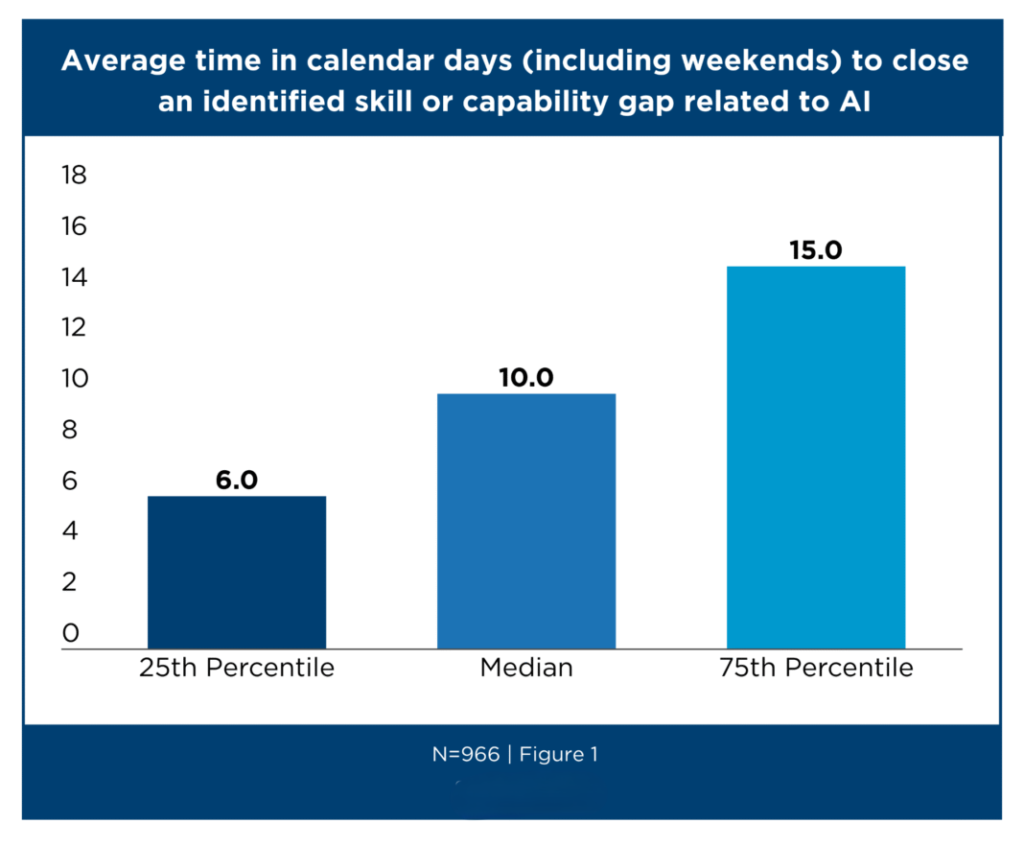
The assumptions above can make AI skills development feel like a massive undertaking. In reality, APQC benchmarking shows that the cycle time to close an AI skills gap is far shorter than many organizations might assume, with organizations at the median closing gaps in 10 days or fewer.
What a 10-day sprint makes possible
Closing an AI skills gap in 10 days does not mean an organization becomes fully “AI ready.” It means something more practical and more immediate: A priority gap can be closed quickly enough to reduce risk, enable more responsible use and bring informal experimentation into clearer focus.
Closing gaps quickly requires treating AI enablement as an operational problem to be solved, not as a long-term transformation that needs to be perfectly planned in advance. That means you should focus your effort on the AI skills that matter most to your organization right now, while recognizing that AI readiness must continue to evolve after the initial gap is closed.
Five moves that make a 10-day sprint work
The five practices below explain how you can close AI skills gaps through a 10-day sprint, while also laying the groundwork for ongoing readiness once the sprint ends.
Establish a lightweight center of AI expertise
A clear point of coordination helps prevent training efforts from stalling on approvals, conflicting guidance, or unclear ownership. This does not require a formal center of expertise (this can always come later), but it does require a small group responsible for aligning standards, messaging and priorities so decisions can move quickly.
Rapidly scope your learning needs
Rather than attempting to assess all possible AI skills at once, aim to prioritize high-risk or high-impact use cases and the roles most likely to encounter them. Scoping in this way will keep your sprint from expanding into a broad, slow-moving initiative.
Leverage internal expertise
Employees who are already using AI tools can accelerate learning when they share their knowledge with others. Communities of Practice bring these practitioners together to learn from experts, exchange examples, apply lessons learned and develop practical guidance tied to real work. These groups, along with reliable and accessible information repositories, help to shorten development time and increase relevance, especially during a short enablement sprint.
Outsource selectively to remove bottlenecks
As much as you can, keep foundational training in-house for speed and cost control. When you need expertise for advanced AI topics, external support can help you maintain momentum. Used strategically, outsourcing fills specific gaps without turning enablement into a large, vendor-driven program that slows execution.
Reinforce learning in the flow of work
After the sprint, continue to build opportunities for learning in the flow of work. A mix of formal learning modules, job aids, Communities of Practice, and ongoing guidance will help prevent skill decay and allow capabilities to evolve as tools, policies and use cases change over time.
Moving forward without waiting
AI readiness is not built all at once, but it doesn’t have to move slowly either. A focused sprint can close your most critical AI skill gaps and create a foundation for the work that follows.
Source: GWFM Research & Study