GWFM Recommends Dual-Vendor Strategies: Performance vs. Specialization in the AI Workforce Era

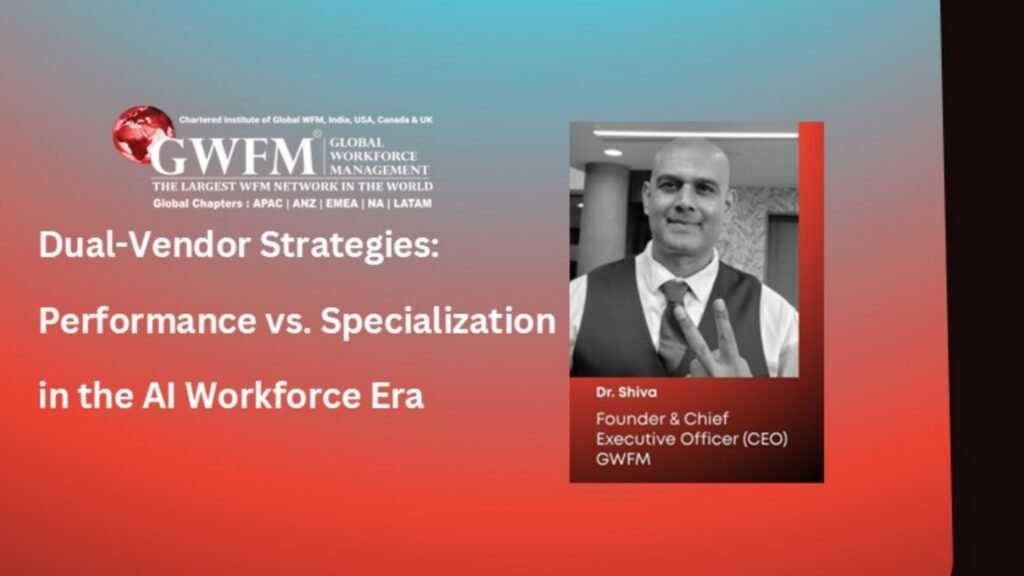
Dual-vendor models—Competitive (performance rivalry for commodities) vs. Segmentation (specialized depth for complex needs)—plus hybrids (70/30) deliver risk-proofing and innovation. GWFM research reveals 30-50% efficiency gains in AI-human orchestration, urging a break from siloed vendors.
In the volatile economic landscape of 2026, the “single-source” procurement model has become a legacy risk. To maintain agility amidst AI-driven workforce shifts, organizations must move toward sophisticated Dual-Vendor Orchestration.
Both vendors provide the same product/service and compete continuously on:
- Pricing
- SLA performance
- Quality metrics
- Innovation contribution
- Speed of delivery
Business volume is split (e.g., 60:40 or 50:50) and periodically reallocated based on performance scorecards.
This white paper examines two primary frameworks: the Competitive Dual-Vendor Model, which leverages performance-driven rivalry to optimize costs in product ( Example of Productivity tool, Workforce Management, HCM, Analytics tool), and BPO, and the Strategic Segmentation Model, which prioritizes domain expertise for complex WFM technology. For large-scale enterprises, GWFM recommends a Hybrid Approach (70/30 split) to balance stability with innovation. In an era where AI agents and human talent must coexist, a dual-vendor strategy is the ultimate hedge against model lock-in and operational stagnation.
Introduction: The New Frontier of Vendor Orchestration
Dr. Shiva, Founder of GWFM, and his team have invested extensive research across productivity, WFM, RM, and analytics tools—uncovering transformative multi-vendor strategies that empower organizations to transcend legacy vendor dependencies and unlock unprecedented agility in the AI era.
As we navigate 2026, the workforce management (WFM) challenge has evolved from simply managing “heads” to orchestrating a complex ecosystem of human talent and agentic AI. We are currently witnessing a dual-edged sword: a persistent shortage of specialized human skills coupled with an overcapacity of AI agentic tools.
For the GWFM community, the question is no longer if you should have multiple vendors, but how you govern them. A poorly managed multi-vendor environment creates administrative bloat; a well-orchestrated one creates a self-optimizing engine. By adopting a dual-vendor strategy, leaders can ensure resilience in staffing, BPO, and IT services, while simultaneously accelerating the integration of AI into their core operations.
Strategy 1: Competitive Dual-Vendor (Performance-Driven Model)
This model treats vendors as high-performance athletes in a continuous race. It is designed for environments where output is measurable and the market is mature.
The Concept
Both vendors provide identical services. Business volume is not static; it is a “living” allocation (e.g., 60:40) that shifts based on quarterly performance scorecards.
Key Performance Indicators (KPIs)
- Cost Efficiency: Unit price vs. market benchmark.
- SLA & Quality: Accuracy, turnaround time, and NPS.
- Innovation Contribution: Frequency of proactive process improvements.
Strategic Advantage
| Advantage | Business Impact |
| Cost Optimization | Constant rivalry prevents “price creep” and keeps margins lean. |
| Performance Discipline | A “Challenger” vendor prevents the “Primary” from becoming complacent. |
| Risk Mitigation | If one vendor suffers a breach or failure, 40-50% of capacity is already live elsewhere. |
| Negotiation Power | The buyer retains the ultimate leverage: the ability to shift volume. |
Best Fit For: High-volume staffing, standardized BPO, and commodity SaaS platforms.
Strategy 2: Strategic Segmentation (Specialization Model)
In this model, the two vendors are not rivals, but specialized partners. They own distinct “territories” within your ecosystem.
The Concept
Instead of competing on the same tasks, vendors are segmented by geography (e.g., NA vs. APAC), complexity (Standard vs. High-Touch), or specific customer segments.
Strategic Advantage
| Advantage | Business Impact |
| Deeper Expertise | Vendors invest in deep domain knowledge rather than “winning the next bid.” |
| Operational Stability | Reduces the “noise” of constant performance reviews and internal rivalry. |
| Relationship Strength | Fosters long-term roadmap alignment and co-innovation. |
| Scalability | Simplifies global expansion by assigning regions to the vendor with the best local footprint. |
Best Fit For: Complex WFM consulting, enterprise-grade platforms, and highly regulated niche services.
The Advanced Hybrid Approach: The 70/30 Split
For large enterprises, GWFM recommends the Hybrid Model. This involves a 70% Primary Vendor (providing scale and stability) and a 30% Challenger Vendor (driving innovation and price pressure). This “70/30” split is re-evaluated annually, allowing the challenger to earn more share through exceptional performance or AI-led breakthroughs.
The X-Factor: Advantages in the AI Age (2026 Context)
The rise of Agentic AI—AI that can plan and execute tasks independently—makes the dual-vendor strategy a necessity for three reasons:
- Avoiding Model Lock-in: Different vendors often rely on different LLMs (Large Language Models). A dual-vendor strategy ensures your business isn’t tethered to a single AI architecture that may become obsolete.
- Algorithmic Benchmarking: Use Vendor A’s AI to benchmark Vendor B’s human output (and vice-versa). This creates a “Human-AI Feedback Loop” that drives 55%+ efficiency gains.
- Resilience against “AI Burnout”: As AI models face data degradation or “hallucination cycles,” having a segmented vendor who specializes in manual quality oversight provides a critical safety net.
This is where strategy meets execution. To move a room full of executives, you need a scorecard that removes emotion from the equation and a slide deck that frames the dual-vendor approach as a risk-mitigation engine, not just a procurement tactic.
The Performance-Driven Vendor Scorecard
This scorecard is designed for the Competitive Dual-Vendor Model. It uses a weighted scoring system to objectively determine how volume should be reallocated during the next review.
| Category | Key Metric (KPI) | Weight | Vendor A Score (1-10) | Vendor B Score (1-10) | Weighted Total |
| Operational Delivery | Fill Rate / SLA Compliance | 30% | |||
| Financial Efficiency | Unit Cost vs. Budgeted Target | 25% | |||
| Quality of Output | NPS / Accuracy / Error Rate | 20% | |||
| Innovation & AI | AI-led Automation / Process Gains | 15% | |||
| Strategic Agility | Speed to Scale / Crisis Response | 10% | |||
| TOTAL SCORE | 100% | 0.0 | 0.0 |
Pro-Tip for 2026: Notice the 15% weight on AI Innovation. In today’s market, if a vendor isn’t proactively showing you how they are reducing their own manual labor via AI, they are passing their inefficiencies on to your bottom line.
Through rigorous analysis of productivity, WFM, RM, and analytics landscapes, Dr. Shiva Kumar and the GWFM team illuminate paths beyond outdated vendors—equipping leaders to architect AI-resilient ecosystems that redefine organizational potential.
Competitive for staffing ecosystems; Segmentation for WFM tech. End with CTA: “Join GWFM summits to operationalize these strategies.”
Sources: GWFM Strategic Consulting Research and Extensive Interviews with the Global Leaders.